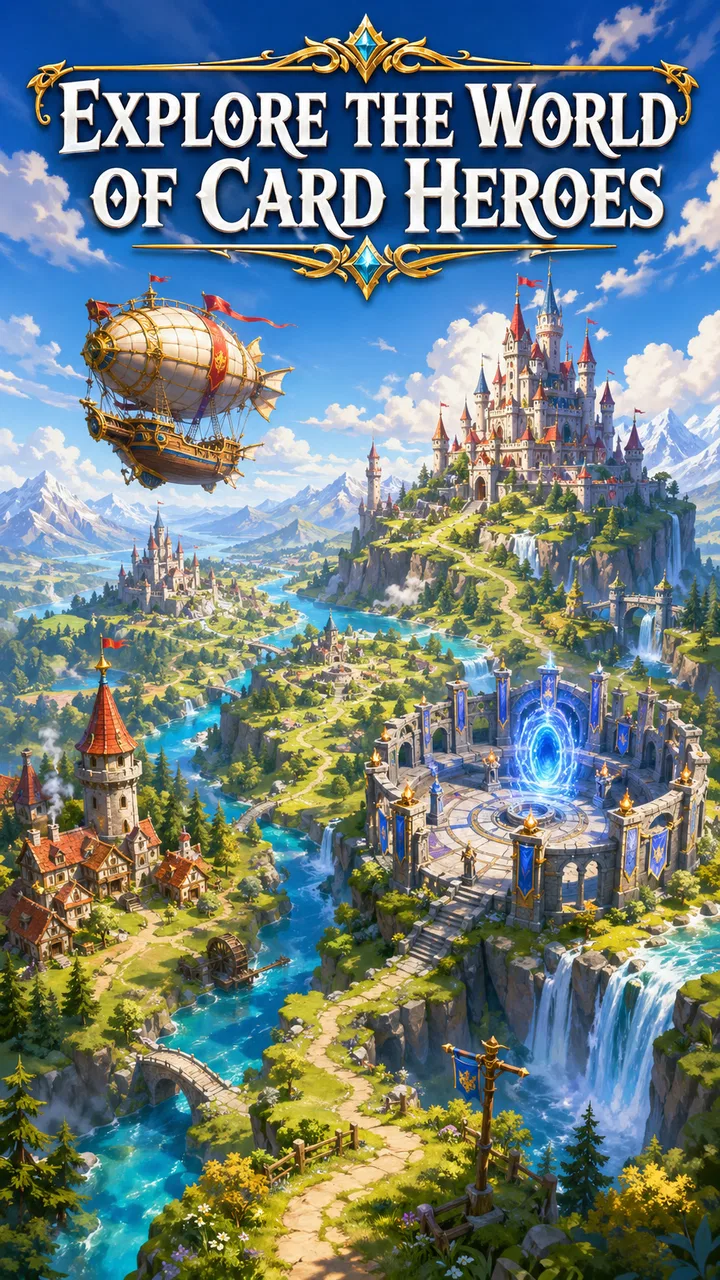
Card Heroes: TCG/CCG Card Wars
- 4.5
- Rating
- 1.00M
- Installs
- Free
- Price
 Analysis by App-foxy
I spent time with Card Heroes: TCG/CCG Card Wars as a mobile card game, and my first impression was that it wants every match to feel like a small tactical duel rather than a quick game of chance. The basic appeal is easy to understand: build a magical deck, choose your cards carefully, and try to outthink the opposing side. That makes it a natural fit for players who enjoy card battles but want something more focused than a traditional solitaire game and less time-consuming than a large tabletop collection.
The game is free to download, which makes trying it straightforward. It is published by CHEELY INTERACTIVE STUDIO - FZCO and has reached over a million installs, with an average rating of 4.5 from roughly seventy-one thousand ratings. Those figures suggest that it has found a substantial audience, but they do not remove the need to look closely at how the game feels once the initial novelty wears off. My experience is that its strongest quality is the decision-making around a deck and a turn, while its biggest question for a careful player is how much long-term progress depends on spending.
It is marked for Everyone 10+, runs on Android starting with version 7.0, and the current version is 2.3.4576. The age guidance is worth keeping in mind for families: this is a competitive card game with a fantasy battle theme, not a quiet puzzle or a purely educational card app. I would recommend approaching it as a strategy game first and a collection game second.
You May Also Like

 Blood Strike: 2.5 Anniversary
Blood Strike’s Loadouts Turn Every Drop Into a Tactical Gamble
A close look at Blood Strike’s custom loadouts: how fast access to signature weapons reshapes its battle royale rhythm, rewards preparation, and narrows the gap between fights.

 Pandora - Music & Podcasts
Pandora’s Music Is Easy to Start, but Harder to Recover
Pandora’s strength is its low-effort path from a seed to a station. Its weak spot is how much confidence it asks you to place in connection, setup, and quiet recovery.

 8 Ball Pool
 Is Built on Rivalries, Rematches, and Routine
A close look at the rivalries, rematches, shared routines, and unanswered safety questions that turn a quick pool match into a persistent mobile community.

 Samsung Music
’s Quiet Strength Is Playing What You Already Own
Its reach comes less from spectacle than from dependable access to a personal library. That simplicity is both the app’s strongest retention engine and its ceiling.

 AccuWeather: Weather Radar
AccuWeather Review: A Quick, Clear Forecast for Everyday Decisions
For everyday plans, the best forecast is the one you can understand quickly. AccuWeather makes rain timing, radar, and local conditions easy to act on, with a few trade-offs.

 Hill Climb Racing
Why Hill Climb Racing Still Turns Crashes Into One More Run
A tiny car, a bumpy hill and one more upgrade: Hill Climb Racing keeps resurfacing because its simple chaos makes every near-miss feel personal.
More From Our News Desk
View All News


How the card battles feel in everyday play
I find the everyday appeal of these battles in the space they leave for a deliberate choice, rather than in any promise of a quick win. A useful way to approach a match is to notice which decisions you can actually learn from, then carry that observation into your next deck test. That distinction also helps set realistic expectations for how quickly play should feel.
A good fit for short, deliberate sessions
What I like about this type of design is that it gives a short break some structure. If I have a few minutes while waiting for an appointment, I can think about a deck choice, play a battle, and stop without needing to commit to a long story chapter. That is different from many role-playing games, where leaving in the middle of a mission can feel inconvenient. Here, the attraction comes from making a few meaningful choices and seeing whether they work.
The fantasy presentation also gives the cards a clear purpose. Instead of treating the deck as a collection of unrelated icons, I read each choice as part of a battle plan: pressure the opponent, protect a useful card, or hold back a response for a better moment. That rhythm is what kept me interested. The game is most enjoyable when I am adapting rather than simply repeating the same strongest move.
New players should resist the urge to judge a card only by its immediate power. In a card battle, a card that looks impressive can still be awkward if it does not fit the rest of the deck. I found it more useful to ask whether a card supports a reliable plan. A deck with a clear purpose is easier to understand and improve than a pile of individually attractive cards.
The first useful habit: review the deck after a loss
One of the most practical habits I developed was to treat a defeat as a deck review rather than an invitation to spend immediately. After a poor match, I would ask whether I lost because I lacked a response, played too aggressively, or drew a collection of cards that did not work together. That simple pause matters because card games can make every loss feel like proof that the next upgrade is necessary.
This is also where the game differs from a basic casual card app. In a conventional matching or solitaire alternative, improvement usually comes from recognizing patterns or managing a board. In this game, improvement depends more on understanding relationships between cards and on accepting that a strong turn now may create a weak turn later. Players who enjoy that kind of post-match analysis will get more from it than players who only want instant, predictable wins.
What to do when progress starts feeling slow
Free card games often create a tension between learning and collecting. At the beginning, almost every new card can feel useful because it opens a different possibility. Later, the player may become more aware of gaps in a deck or of opponents who appear to have more developed collections. That is the point where I recommend setting a personal goal instead of trying to improve everything at once.
For example, I would choose one deck idea and test it across several sessions before changing it. Constantly rebuilding after every loss makes it difficult to know what actually worked. Keeping the core plan stable while changing one or two choices at a time gives clearer feedback. It also reduces the temptation to treat every new card as an automatic replacement.
The game includes in-app purchases priced from $0.99 to $99.99 per item. That range is important for anyone deciding whether the free route is comfortable. The low entry price may be manageable for an occasional convenience, while the upper end represents a much more serious spending decision. I would not start buying simply because a match went badly; I would first check whether I still enjoy the strategic loop without purchases.
Spending pressure and the sensible stopping point
My advice is to decide on a limit before opening the shop. This is especially useful in a collection-focused game because the desire to complete a deck can be stronger than the practical benefit of one more card. If I cannot explain exactly what a purchase changes in my play, I would skip it. A vague feeling that it might make progress smoother is not a strong enough reason.
There is also a difference between paying for convenience and paying to solve frustration. A player who already understands the game may knowingly buy something to save time. A new player who is still learning the basics can easily spend without knowing whether the purchase addresses a real weakness. I think the healthier approach is to play long enough to identify a repeatable problem, then decide whether that problem is worth paying to reduce.
My clearest spending advice is simple: treat every purchase as optional, not as part of the entry fee. The game is free, but a free starting point does not guarantee that every later stage will feel equally comfortable without spending. Since player budgets and tolerance for slower progress differ, this is a personal decision rather than a universal verdict.
Fairness: what I can judge and what I cannot
Fairness in a card game has two layers. The first is the fairness of the battle itself: whether careful decisions matter and whether a player can understand why a match was won or lost. The second is progression fairness: whether access to stronger or more flexible cards is comfortable for someone who stays free. I found the first layer more satisfying than the second is easy to judge from a short review period.
The purchase range means that spending is a real part of the product, so competitive-minded players should pay attention to how their experience develops over time. I would not describe the game as automatically unfair merely because it sells optional items. At the same time, I would not promise a perfectly level competitive environment without knowing how those purchases interact with collection growth and battle performance in every mode.
That distinction is useful when comparing it with ordinary card alternatives. A casual card app usually asks whether you can solve the current hand or board. A collectible battle game asks whether your wider collection supports enough different answers. The second model can be more rewarding for a strategist, but it can also make the gap between a new player and an established player feel more noticeable.
If fairness is your top priority, I would approach the game experimentally. Play without spending first, use the same deck idea for a meaningful stretch, and notice whether losses teach you something actionable. If you regularly feel that the result was decided before your choices mattered, the game may not suit you, even if the fantasy card battles themselves are attractive.
Three practical ways to get more from the deck system
First, keep a small mental record of why a deck fails. “I lost” is too broad to help. “I had no answer when the opponent changed pressure” or “my opening hand was too slow” points toward a specific adjustment. This turns each match into useful information and prevents random card swapping.
Second, separate experimentation from serious play. I like using one deck as a dependable baseline and another as a testing space. That way, a new idea can fail without making every session feel unstable. It is a small workflow change, but it makes collection games less tiring because not every match carries the same expectation.
Third, do not confuse a larger collection with a better understanding of the game. More cards create options, but options only help when I know what role they serve. I would rather learn a compact strategy thoroughly than chase every possible combination. This is particularly valuable for players who want to avoid unnecessary purchases.
Who should play it, and who should skip it?
I think it is a good choice for someone who enjoys fantasy themes, card-based planning, and the satisfaction of refining a strategy over repeated battles. It also suits players who like games that can be played in short sessions but still reward patient thinking. The free price makes it reasonable to test, and the broad install base means it is not an obscure experiment with no established audience.
I would be more cautious if you dislike collection mechanics, become frustrated when progress is not immediate, or want every opponent to have exactly the same resources. Players who prefer a pure skill test may be happier with a fixed-deck card game, a traditional board-game adaptation, or a puzzle card app where the available tools are identical for everyone. Those alternatives usually offer less collection excitement, but they can also reduce spending concerns and progression anxiety.
Parents should also consider the age guidance rather than assuming that “card game” means harmless solitaire. The Everyone 10+ rating reflects a fantasy battle setting and makes it better suited to older children and adults than to very young players. If a child uses it, I would set a clear rule about purchases before handing over the device.
Technical expectations and long-term trust
The current version, 2.3.4576, shows that the game continues to be distributed in an updated form. I would still keep the usual practical habits for any free game with purchases: install it through the official mobile store, keep the device software compatible, and review purchase controls before playing. Those steps do not change the game itself, but they make the experience easier to manage.
What matters most for long-term trust is whether the game lets players understand their progress and make informed choices. I am comfortable with a free card game offering optional purchases when the player can decide calmly. I am less comfortable when a player feels pushed to buy simply to recover from a losing streak. My recommendation is therefore conditional: enjoy the battles first, and only spend when the value is clear to you.
My final view after weighing strategy against spending
Card Heroes: TCG/CCG Card Wars works best when I treat it as a tactical deck-building hobby rather than a race to collect everything. The battles give the game its identity, and the magical card theme makes the strategic choices feel more engaging than a plain numbers exercise. I also appreciate that it can fit into ordinary spare moments while still offering enough depth for players who like reviewing mistakes.
The main limitation is the uncertainty that comes with a free collectible card game and a purchase system reaching $99.99 per item. I would not recommend spending on impulse, and I would not choose this as my first option for a perfectly even competitive environment. The right question is whether you enjoy experimenting with cards enough to accept a gradual progression path and the possibility that spending may become tempting.
For me, the verdict is positive with boundaries. I would recommend trying it free, building around one clear strategy, and giving each change time to prove itself. If that process feels rewarding, the game can become a satisfying card-battle routine. If the collection pressure matters more than the decisions in the match, a fixed-deck alternative will probably be the better choice. That is the honest dividing line: play for the strategy, not for the pressure to own everything.
FAQs for Card Heroes: TCG/CCG Card Wars
01What is Card Heroes: TCG/CCG Card Wars?
Card Heroes: TCG/CCG Card Wars is a collectible card game focused on building a team of heroes, collecting cards, and battling opponents through strategic turn-based combat. Each hero and card has different abilities, strengths, and weaknesses, so success depends on creating a balanced deck and using skills at the right moment rather than simply relying on powerful cards.
02How does the gameplay work in Card Heroes?
Matches are based on tactical card battles in which you deploy heroes, manage available resources, and use attacks or special abilities to defeat the opposing team. Before entering a fight, you can adjust your lineup and deck to suit different enemies. Understanding card combinations, positioning, timing, and each hero’s role is essential for progressing through increasingly difficult battles.
03Can Card Heroes: TCG/CCG Card Wars be played offline?
Card Heroes is primarily designed as an online game, especially for features involving competitive battles, events, account progress, and updated content. Some parts of the experience may load without a constant connection, but offline availability can vary depending on the version and device. For the most reliable experience, players should use a stable internet connection when launching the game or entering battles.
04Is Card Heroes free to download and does it include in-app purchases?
The game is generally available as a free download, allowing players to begin collecting cards and completing battles without paying upfront. However, it may include optional in-app purchases for card packs, resources, upgrades, or other progression-related items. You can usually play without spending money, although free players may need more patience to unlock certain content and improve their collection.
05Is Card Heroes suitable for beginners and younger players?
Card Heroes is approachable for newcomers because the early stages introduce the basic battle systems, card abilities, and team-building mechanics gradually. Nevertheless, the game becomes more strategic as opponents grow stronger and may require careful planning. Parents should also review the game’s age rating, advertising, chat or social features, and in-app purchase settings before allowing younger players to use it.
Pros
- Quick matches make it easy to play during short breaks.
- Distinct card abilities create plenty of tactical combinations.
- Regular events provide extra goals beyond the main campaign.
- The colorful fantasy artwork gives every deck a lively identity.
- Progression rewards encourage experimentation with different heroes.
Cons
- Some upgrades can take a long time without spending premium currency.
- The large card collection may feel overwhelming for new players.
- Matchmaking can occasionally place beginners against stronger decks.
- Random card draws may decide the outcome of otherwise close battles.
- Online features require a stable connection to play reliably.

Card Heroes: TCG/CCG Card Wars
Gallery